
Freehold Jewish Center
CONGREGATION AGUDATH ACHIM
DID YOU KNOW? · Hidden Gems from the Weekly Torah Portion
Vayetzei: A prayer at nightfall, and strength at the well.
Parashat Vayetzei | וַיֵּצֵא
Genesis 28:10–32:3
Shabbat November 21, 2026 · 11 Kislev 5787
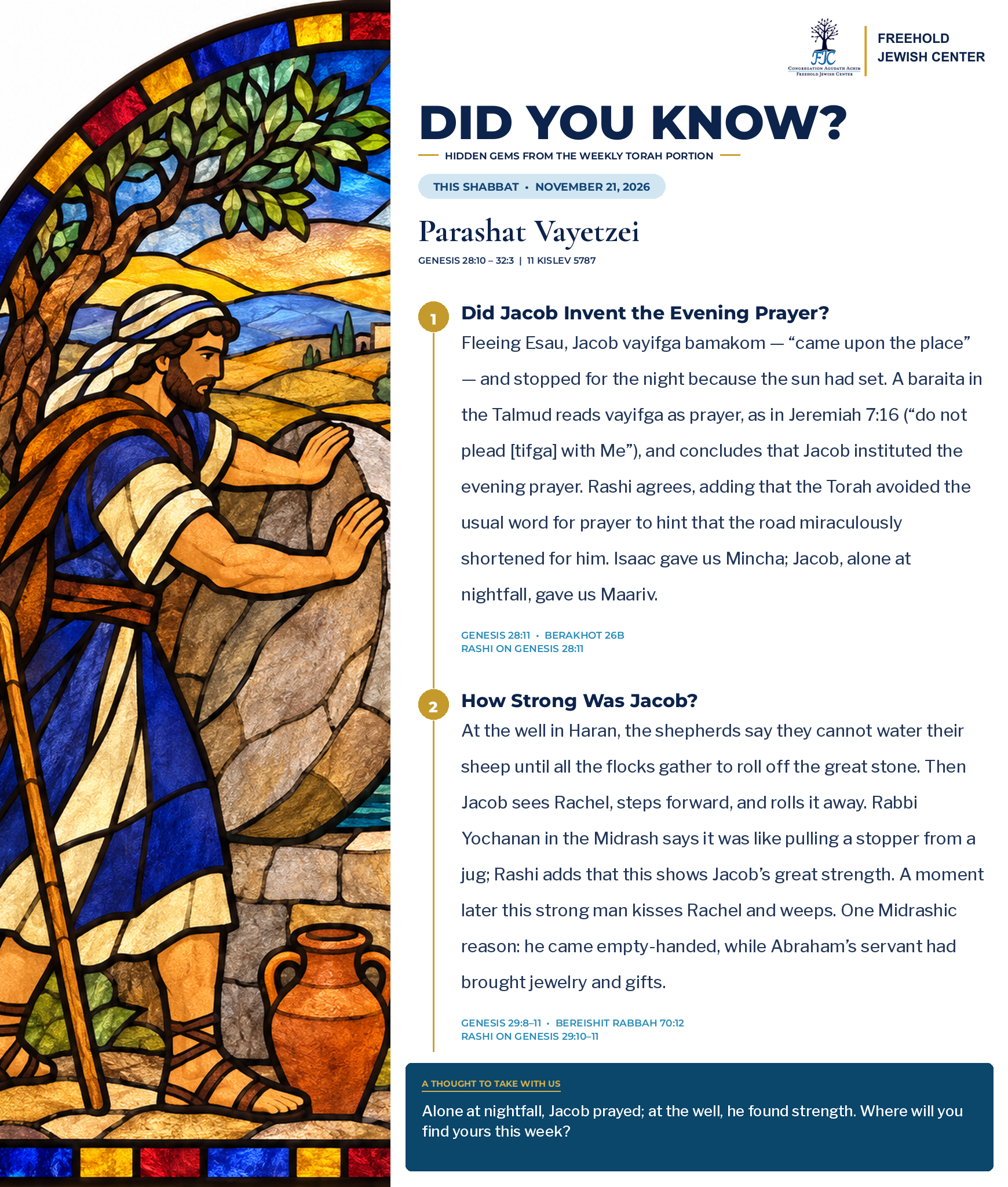
Did Jacob invent the evening prayer when he came upon the place at nightfall? How strong was Jacob when he rolled the stone from the well for Rachel? These two Vayetzei teachings invite us to listen closely to a quiet verb, and to a moment of unexpected strength.

For more discussion — Parashat Vayetzei
Shabbat, November 21, 2026 · 11 Kislev 5787 · Genesis 28:10–32:3
Where do we find G-d, and where do we find strength, when we are far from home? Vayetzei opens with Jacob fleeing Esau, alone on the road from Beer-sheba to Haran. He stops at nightfall, dreams of a ladder, and wakes to say that G-d was in this place. Then he reaches a well, meets Rachel, and begins twenty years in Laban’s household, marrying Leah and Rachel and raising a family. Two rabbinic readings focus on two moments of that journey: a night stop that the sages hear as the first evening prayer, and a heavy stone that Jacob rolls from a well. Read the Hebrew with its English translation, then distinguish the Torah’s narrative, the sages’ interpretations, and our own applications.
Gem 1 — Did Jacob invent the evening prayer?
The Torah — Genesis 28:11
וַיִּפְגַּע בַּמָּקוֹם וַיָּלֶן שָׁם כִּי־בָא הַשֶּׁמֶשׁ וַיִּקַּח מֵאַבְנֵי הַמָּקוֹם וַיָּשֶׂם מְרַאֲשֹׁתָיו וַיִּשְׁכַּב בַּמָּקוֹם הַהוּא׃
“He came upon a certain place and stopped there for the night, for the sun had set. Taking one of the stones of that place, he put it under his head and lay down in that place.” (Genesis 28:11, JPS translation.)
An ordinary verb for an ordinary stop
Jacob has left Beer-sheba for Haran (28:10). The next verse says vayifga bamakom: he “came upon” or “encountered” the place, and stayed the night because the sun had set. In its plain sense the verb paga describes reaching or meeting something; Rashi points to Joshua 16:7 and 19:11, where a border “reaches” a town. The Torah does not name the place yet (it will be called Beth-el in 28:19), and it does not say that Jacob prayed.
Notice what the verse emphasizes instead: the word makom, “place,” appears three times in this one verse. The rabbis will read both words, vayifga and bamakom, as clues.
The Talmud hears a prayer
In Chayei Sara we met this passage through Isaac; this week it reaches Jacob. Berakhot 26b records a dispute about the origin of the three daily services. Rabbi Yosei son of Rabbi Chanina says that the prayers were instituted by the Patriarchs; Rabbi Yehoshua ben Levi says that they were instituted to correspond to the daily Temple offerings. A baraita supporting Rabbi Yosei assigns one service to each Patriarch: Abraham the morning prayer (Genesis 19:27), Isaac the afternoon prayer (Genesis 24:63), and Jacob the evening prayer, from our verse.
The Talmud — Berakhot 26b
יַעֲקֹב תִּקֵּן תְּפִלַּת עַרְבִית, שֶׁנֶּאֱמַר: ״וַיִּפְגַּע בַּמָּקוֹם וַיָּלֶן שָׁם״, וְאֵין ״פְּגִיעָה״ אֶלָּא תְּפִלָּה, שֶׁנֶּאֱמַר: ״וְאַתָּה אַל תִּתְפַּלֵּל בְּעַד הָעָם הַזֶּה וְאַל תִּשָּׂא בַעֲדָם רִנָּה וּתְפִלָּה וְאַל תִּפְגַּע בִּי״
“Jacob instituted the evening prayer, as it is said: ‘He encountered [vayifga] the place and stayed there for the night’—and pegi’ah means nothing other than prayer, as it is said: ‘As for you, do not pray for this people, do not raise a cry of prayer on their behalf, and do not plead [tifga] with Me.’” (Berakhot 26b; our translation.)
The proof rests on Jeremiah 7:16, where G-d tells the prophet not to intercede for the people. There paga stands in a list with “pray” and “a cry of prayer,” so the sages read it as pleading or intercession. The Gemara ultimately harmonizes the two views: the Patriarchs instituted the prayers, and the sages later anchored them in the offerings. As with Isaac and Mincha, this is a rabbinic reading of a single word; it explains why Jacob is linked with Maariv, not how the text of the service developed.
The proof text — Jeremiah 7:16
וְאַתָּה אַל־תִּתְפַּלֵּל בְּעַד־הָעָם הַזֶּה וְאַל־תִּשָּׂא בַעֲדָם רִנָּה וּתְפִלָּה וְאַל־תִּפְגַּע־בִּי כִּי־אֵינֶנִּי שֹׁמֵעַ אֹתָךְ׃
“As for you, do not pray for this people, do not raise a cry of prayer on their behalf, do not plead with Me; for I will not listen to you.” (Jeremiah 7:16, JPS translation.)
A prayer at the edge of darkness
Rashi — Rashi on Genesis 28:11
ויפגע. כְּמוֹ וּפָגַע בִּירִיחוֹ וּפָגַע בְּדַבָּשֶׁת (יהושע ט”ז וי”ט) וְרַבּוֹתֵינוּ פֵּרְשׁוּ לְשׁוֹן תְּפִלָּה (ברכות כ”ו), כְּמוֹ וְאַל תִּפְגַּע בִּי (ירמיהו ז’), וְלָמַדְנוּ שֶׁתִּקֵּן תְּפִלַּת עַרְבִית. וְשִׁנָּה הַכָּתוּב וְלֹא כָּתַב וַיִּתְפַּלֵּל, לְלַמֶּדְךָ שֶׁקָּפְצָה לוֹ הָאָרֶץ, כְּמוֹ שֶׁמְּפֹרָשׁ בְּפֶרֶק גִּיד הַנָּשֶׁה (חולין צ”א):
“Vayifga—like ‘and it reached [ufaga] Jericho’ and ‘it reached Dabbesheth’ (Joshua 16 and 19). But our Rabbis explained it as a term for prayer (Berakhot 26), as in ‘do not plead [tifga] with Me’ (Jeremiah 7), and we learn that he instituted the evening prayer. Scripture changed its wording and did not write ‘he prayed’ in order to teach you that the land leapt toward him, as explained in the chapter Gid HaNasheh (Chullin 91b).” (Rashi on Genesis 28:11; our translation.)
Rashi keeps both meanings
Rashi first gives the plain meaning, “reached,” and only then cites “our Rabbis” for the meaning “prayed.” He also asks the natural question: if the Torah meant prayer, why not use the common verb vayitpallel? His answer is that the unusual word carries a second message, “the land leapt toward him”—the road was miraculously shortened.
Rashi points to the Talmud’s source, Chullin 91b. There Rabbi Yitzchak tells the story behind the verse. Jacob had already reached Haran when he stopped and asked himself a question:
Rabbi Yitzchak — Chullin 91b
כִּי מְטָא לְחָרָן אָמַר: אֶפְשָׁר עָבַרְתִּי עַל מָקוֹם שֶׁהִתְפַּלְּלוּ אֲבוֹתַי וַאֲנִי לֹא הִתְפַּלַּלְתִּי?
“When he arrived at Haran, he said: Is it possible that I passed a place where my fathers prayed, and I did not pray?” (Chullin 91b, excerpt; our translation.)
When he decided to turn back, the land contracted for him, and immediately “he encountered the place.” In this telling, Jacob’s evening prayer begins with regret for a missed moment and a decision to go back.
The Midrash adds a twist
Bereshit Rabbah 68:9 also reads vayifga as prayer, and it attributes the three-Patriarchs teaching to Rabbi Yehoshua ben Levi, the same sage whom the Babylonian Talmud names as holding the opposing view (that the prayers correspond to the offerings). Sources do not always assign a teaching to the same speaker. The Midrash also cites Rabbi Shmuel bar Nachman, who links the three prayers to “the three times that the day changes,” and gives an evening prayer to be brought out of darkness into light.
The same Midrash passage opens by asking why G-d is called HaMakom, “the Place”: because He is the place of the world, and the world is not His place. Read with that idea, vayifga bamakom can suggest that Jacob “met the Place.” That is a midrashic association, not the plain meaning of the verse.
Optional—but never quite
Berakhot 27b records a famous disagreement about the status of the evening prayer.
The Talmud — Berakhot 27b
תְּפִלַּת עַרְבִית: רַבָּן גַּמְלִיאֵל אוֹמֵר חוֹבָה, רַבִּי יְהוֹשֻׁעַ אוֹמֵר רְשׁוּת
“The evening prayer: Rabban Gamliel says it is obligatory; Rabbi Yehoshua says it is optional.” (Berakhot 27b, excerpt; our translation.)
The Talmud tells how this disagreement led to a public confrontation, after which the sages removed Rabban Gamliel, for a time, as head of the academy (Berakhot 27b–28a). Later Jewish practice treats Maariv as a fixed daily service even though its original status was debated. This is background, not a halakhic ruling.
Waking up to the place
The Torah — Genesis 28:16
וַיִּיקַץ יַעֲקֹב מִשְּׁנָתוֹ וַיֹּאמֶר אָכֵן יֵשׁ ה׳ בַּמָּקוֹם הַזֶּה וְאָנֹכִי לֹא יָדָעְתִּי׃
“Jacob awoke from his sleep and said, ‘Surely G-d is present in this place, and I did not know it!’” (Genesis 28:16, JPS translation.)
After the dream of the ladder, Jacob wakes and realizes what he had not known. Rashi on 28:16 explains the regret simply: “for had I known, I would not have slept in such a holy place.” For discussion, consider how evening prayer can work as a way of noticing, before sleep, that G-d may have been present in the day we just lived. That is our application, not a claim of the sources.
At the Shabbat table — Gem 1
- The plain meaning of vayifga is “reached” or “came upon.” What does the reading “prayed” add to the story of a man fleeing his brother at nightfall?
- In Chullin 91b, Jacob turns back because he passed a place of prayer without praying. When have you realized you missed an important moment, and could you go back?
- Abraham is linked with morning, Isaac with afternoon, Jacob with night. How might each Patriarch’s life story fit his time of day?
- Rabbi Yehoshua called Maariv optional; later practice made it fixed. What is gained by making a prayer “required,” and what is gained by leaving room for choice?
A bridge to the second gem
Jacob’s first night away from home is marked by stones: he takes “from the stones of the place” for his head (28:11), and in the morning he sets up a stone as a pillar (28:18). His next encounter, at the well in Haran, also turns on a stone—this time a heavy one that blocks the water. Linking the two scenes through their stones is our study theme, not a connection the sources themselves draw.
Gem 2 — How strong was Jacob?
The Torah — Genesis 29:8
וַיֹּאמְרוּ לֹא נוּכַל עַד אֲשֶׁר יֵאָסְפוּ כׇּל־הָעֲדָרִים וְגָלְלוּ אֶת־הָאֶבֶן מֵעַל פִּי הַבְּאֵר וְהִשְׁקִינוּ הַצֹּאן׃
“But they said, ‘We cannot, until all the flocks are rounded up; then the stone is rolled off the mouth of the well and we water the sheep.’” (Genesis 29:8, JPS translation.)
First hear the story
Jacob arrives at a well in the open field with three flocks of sheep lying beside it, and “the stone on the mouth of the well was large” (29:2). Verse 3 describes the routine: when all the flocks were gathered, the stone would be rolled off, the sheep watered, and the stone returned. Jacob asks the shepherds why they are waiting while it is still broad daylight (29:7), and they answer that they cannot water the sheep until all the flocks gather (29:8). Rashi on 29:8 explains “we cannot”: “to water [them], because the stone is large.”
The Torah — Genesis 29:10
וַיְהִי כַּאֲשֶׁר רָאָה יַעֲקֹב אֶת־רָחֵל בַּת־לָבָן אֲחִי אִמּוֹ וְאֶת־צֹאן לָבָן אֲחִי אִמּוֹ וַיִּגַּשׁ יַעֲקֹב וַיָּגֶל אֶת־הָאֶבֶן מֵעַל פִּי הַבְּאֵר וַיַּשְׁקְ אֶת־צֹאן לָבָן אֲחִי אִמּוֹ׃
“And when Jacob saw Rachel, the daughter of his uncle Laban, and the flock of his uncle Laban, Jacob went up and rolled the stone off the mouth of the well, and watered the flock of his uncle Laban.” (Genesis 29:10, JPS translation; “uncle” is literally “mother’s brother.”)
The Torah does not use the word “alone,” but the contrast is unmistakable: what the shepherds said required all the flocks to gather, Jacob does at once, as soon as he sees Rachel. The verse also names “Laban his mother’s brother” three times.
Rabbi Yochanan and Rashi measure the stone
Rabbi Yochanan — Bereishit Rabbah 70:12
אָמַר רַבִּי יוֹחָנָן כָּזֶה שֶׁהוּא מַעֲבִיר פְּקַק מֵעַל פִּי צְלוֹחִית
“Rabbi Yochanan said: Like one who removes a stopper from the mouth of a jug.” (Bereshit Rabbah 70:12, excerpt; our translation.)
The Midrash gives only the image: the great stone came off as easily as a cork from a bottle. Rashi on Genesis 29:10 quotes that image without naming Rabbi Yochanan and adds the lesson in his own words.
Rashi — Rashi on Genesis 29:10
ויגש יעקב ויגל. כְּמִי שֶׁמַּעֲבִיר אֶת הַפְּקָק מֵעַל פִּי צְלוֹחִית; לְהוֹדִיעֲךָ שֶׁכֹּחוֹ גָּדוֹל (בראשית רבה):
“Jacob drew near and rolled—like one who removes the stopper from the mouth of a flask; to let you know that his strength was great (Bereshit Rabbah).” (Rashi on Genesis 29:10; our translation.)
So the comparison belongs to Rabbi Yochanan in the Midrash, and the explicit moral about Jacob’s strength is Rashi’s.
Strength and tears at the well
The Torah — Genesis 29:11
וַיִּשַּׁק יַעֲקֹב לְרָחֵל וַיִּשָּׂא אֶת־קֹלוֹ וַיֵּבְךְּ׃
“Then Jacob kissed Rachel, and broke into tears.” (Genesis 29:11, JPS translation; literally, “he lifted up his voice and wept.”)
Why did Jacob weep?
One verse after Jacob moves the stone, he weeps. The Torah gives no reason. Bereshit Rabbah 70:12 offers three. First, he compared himself with Abraham’s servant:
The Midrash — Bereishit Rabbah 70:12
וַיִּשָּׂא אֶת קֹלוֹ וַיֵּבְךְּ, לָמָּה בָּכָה, אָמַר, אֱלִיעֶזֶר בְּשָׁעָה שֶׁהָלַךְ לְהָבִיא אֶת רִבְקָה מַה כְּתִיב בֵּיהּ … וַאֲנִי לֹא נֶזֶם אֶחָד וְלֹא צָמִיד אֶחָד
“Why did he weep? He said: When Eliezer went to bring Rebecca, what is written of him? ‘The servant took ten camels…’ (Genesis 24:10)—and I have not one nose-ring and not one bracelet.” (Bereshit Rabbah 70:12, excerpt; our translation.)
Second, he saw that Rachel would not enter the grave with him (the Midrash connects this to Genesis 30:15). Third, he saw people whispering about the kiss.
Rashi — Rashi on Genesis 29:11
לְפִי שֶׁצָּפָה בְרוּח הַקֹּדֶש שֶאֵינָהּ נִכְנֶסֶת עִמּוֹ לִקְבוּרָה. דָּ”אַ לְפִי שֶׁבָּא בְּיָדַיִם רֵקָנִיּוֹת
“He wept—because he foresaw through the holy spirit that she would not enter the grave with him. Another explanation: because he came with empty hands.” (Rashi on Genesis 29:11, excerpt; our translation.)
Rashi selects two of the Midrash’s reasons, specifying that Jacob foresaw Rachel’s burial “through the holy spirit,” and adds a story about why Jacob’s hands were empty: Esau’s son Eliphaz pursued him and took everything he had, since “a poor man is considered as dead.” That Eliphaz story is not in Bereshit Rabbah 70:12; Rashi brings it from elsewhere; the saying about the poor appears in Nedarim 64b. Keep the layers distinct: Torah (he wept), Midrash (three reasons), Rashi (two reasons plus the Eliphaz story).
Strong hands, empty hands
Put the two Rashi comments side by side. On 29:10 Jacob is so strong that a stone meant for many shepherds moves like a cork. On 29:11 the same man weeps because his hands are empty. For a present-day application, consider that strength and vulnerability can belong to the same moment: the person who can lift the heaviest stone may still feel he has nothing to give. That reflection is ours, not an additional claim of the sources.
At the Shabbat table — Gem 2
- The shepherds wait for everyone to gather; Jacob acts at once. When is waiting for the group wise, and when does it become an excuse?
- What do you think gave Jacob his strength at that moment—seeing Rachel, family duty, or something else? What does the Torah’s wording suggest?
- Of the Midrash’s three reasons for Jacob’s tears, which do you find most moving, and why?
- Jacob compares himself to Eliezer, who arrived with camels and jewelry. When have you felt you came “empty-handed,” and what did you still have to offer?
Bring the two gems together
One gem shows Jacob praying alone at nightfall; the other shows him moving a stone that many people could not move. Choose one concrete practice for the coming week: pause for Maariv or a short personal prayer before sleep, or take on one heavy task for someone else without waiting to be asked. Which image—the evening stop or the stone at the well—will help you remember?
A thought to take with us
Alone at nightfall, Jacob prayed; at the well, he found strength. Where will you find yours this week?
Primary texts and commentary — reading links
Freehold Jewish Center · Congregation Agudath Achim | Member access through ShulCloud