
Freehold Jewish Center
CONGREGATION AGUDATH ACHIM
DID YOU KNOW? · Hidden Gems from the Weekly Torah Portion
Vayishlach: A name that remains, and a kiss with all his heart.
Parashat Vayishlach | וַיִּשְׁלַח
Genesis 32:4–36:43
Shabbat November 28, 2026 · 18 Kislev 5787
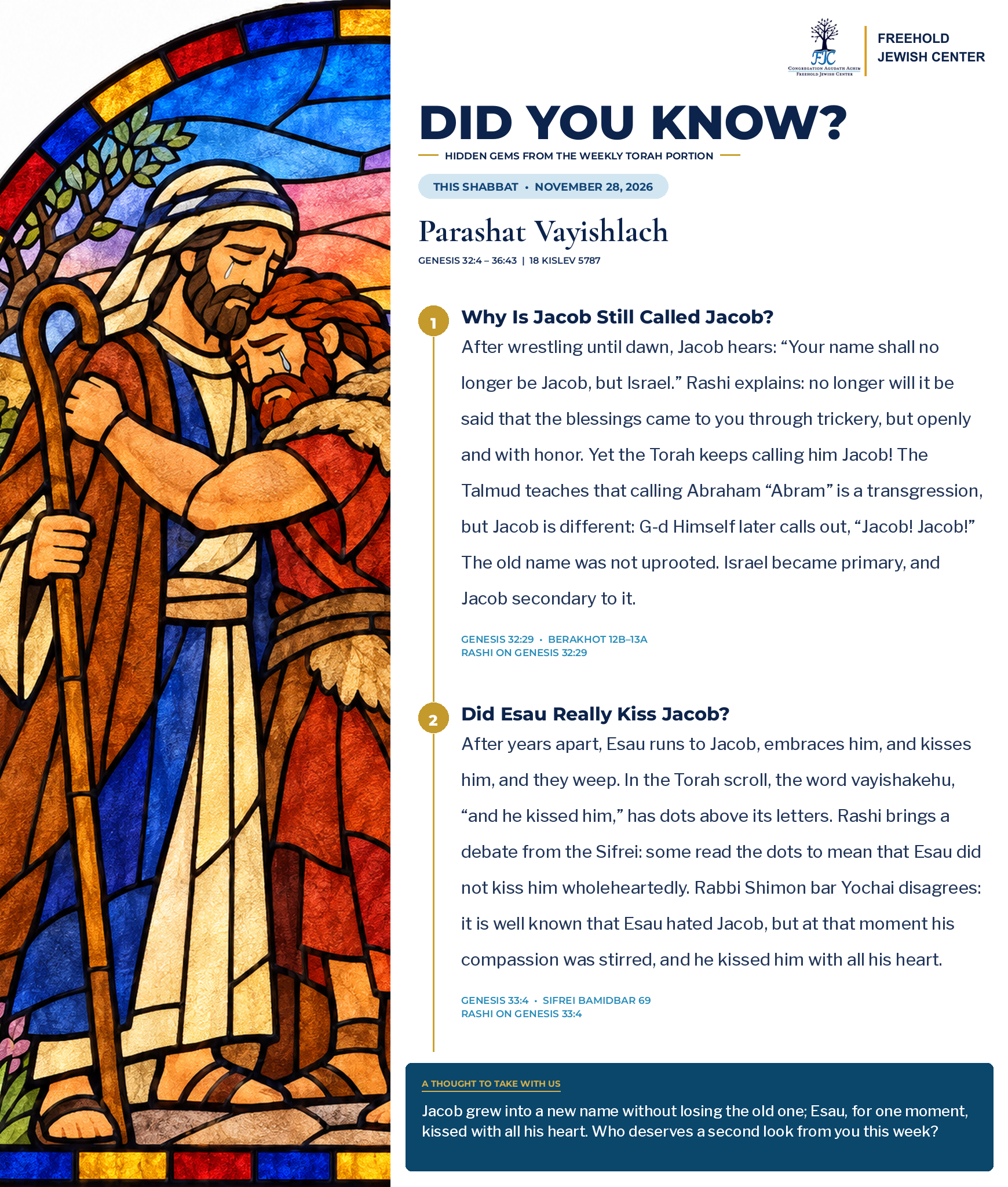
Why is Jacob still called Jacob after he is named Israel? Did Esau really kiss Jacob with all his heart? These two Vayishlach teachings invite us to listen closely to a name that was never uprooted, and to a kiss the Torah scroll marks with dots.

For more discussion — Parashat Vayishlach
Shabbat, November 28, 2026 · 18 Kislev 5787 · Genesis 32:4–36:43
What happens when we finally face the person we have been running from? Vayishlach opens with Jacob, after twenty years in Laban’s household, sending messengers ahead to his brother Esau and learning that Esau is coming toward him with four hundred men. Jacob prepares, prays, and sends gifts. The night before the meeting he is left alone, wrestles with a mysterious figure until dawn, and receives a new name, Israel. The next morning the brothers meet, and Esau runs to embrace him. Two rabbinic readings focus on that night and that morning: a new name that never quite replaces the old one, and a kiss that the Torah scroll marks with dots. Read the Hebrew with its English translation, then distinguish the Torah’s narrative, the sages’ interpretations, and our own applications.
Gem 1 — Why is Jacob still called Jacob?
The Torah — Genesis 32:25
וַיִּוָּתֵר יַעֲקֹב לְבַדּוֹ וַיֵּאָבֵק אִישׁ עִמּוֹ עַד עֲלוֹת הַשָּׁחַר׃
“Jacob was left alone. And a figure wrestled with him until the break of dawn.” (Genesis 32:25, JPS translation; JPS notes that the Hebrew ish, “figure,” is literally “a man.”)
A struggle in the dark
Jacob has brought his wives, children, and possessions across the Jabbok River, and he remains on the far side by himself (32:23–25). The Torah calls his opponent simply ish, “a man,” and never says who he is. When the figure cannot prevail, he strikes Jacob’s hip; when dawn breaks, he asks to be released. Jacob refuses: “I will not let you go, unless you bless me” (32:27). The figure asks his name, and Jacob answers, “Jacob.”
The Torah — Genesis 32:29
וַיֹּאמֶר לֹא יַעֲקֹב יֵאָמֵר עוֹד שִׁמְךָ כִּי אִם־יִשְׂרָאֵל כִּי־שָׂרִיתָ עִם־אֱלֹהִים וְעִם־אֲנָשִׁים וַתּוּכָל׃
“Said he, ‘Your name shall no longer be Jacob, but Israel, for you have striven with beings divine and human, and have prevailed.’” (Genesis 32:29, JPS translation.)
The new name is explained by the verb sarita, “you have striven,” which sounds like the first part of Yisrael. The old name had its own story: at birth Jacob held Esau’s heel (akev, 25:26), and after losing the blessing Esau said bitterly that his brother was well named.
The Torah — Genesis 27:36
וַיֹּאמֶר הֲכִי קָרָא שְׁמוֹ יַעֲקֹב וַיַּעְקְבֵנִי זֶה פַעֲמַיִם אֶת־בְּכֹרָתִי לָקָח וְהִנֵּה עַתָּה לָקַח בִּרְכָתִי וַיֹּאמַר הֲלֹא־אָצַלְתָּ לִּי בְּרָכָה׃
“[Esau] said, ‘Was he, then, named Jacob that he might supplant me these two times? First he took away my birthright and now he has taken away my blessing!’” (Genesis 27:36, JPS translation.)
Rashi: a name that clears the record
Rashi — Rashi on Genesis 32:29
לֹא יֵאָמֵר עוֹד שֶׁהַבְּרָכוֹת בָּאוּ לְךָ בְעָקְבָּה וּרְמִיָּה כִּי אִם בִשְׂרָרָה וְגִלּוּי פָּנִים, וְסוֹפְךָ שֶׁהַקָּבָּ”ה נִגְלֶה אֵלֶיךָ בְּבֵית אֵל וּמַחֲלִיף שִׁמְךָ וְשָׁם הוּא מְבָרֶכְךָ, וַאֲנִי שָׁם אֶהְיֶה וְאוֹדֶה לְךָ עֲלֵיהֶן
“No longer Jacob: It shall no longer be said that the blessings came to you through deceit and trickery, but through nobility and openness. In the end the Holy One, blessed be He, will reveal Himself to you at Beth-el and change your name, and there He will bless you; and I will be there and will acknowledge your right to them.” (Rashi on Genesis 32:29, excerpt; our translation.)
For Rashi, the name “Jacob” carries the memory of Esau’s accusation from 27:36: the man who got ahead by grabbing a heel. The name “Israel” announces that the blessings are his openly and honorably. Rashi also reads the wrestling figure as an angel, and he supports this with the prophet Hosea’s retelling of the night, in which the angel weeps and pleads with Jacob.
The Prophets — Hosea 12:5
וַיָּשַׂר אֶל־מַלְאָךְ וַיֻּכָל בָּכָה וַיִּתְחַנֶּן־לוֹ בֵּית־אֵל יִמְצָאֶנּוּ וְשָׁם יְדַבֵּר עִמָּנוּ׃
“He strove with an angel and prevailed—the other had to weep and implore him. At Beth-el [Jacob] would meet him, there to commune with him.” (Hosea 12:5, JPS translation.)
Rashi explains the angel’s plea as “wait until He speaks with us there,” at Beth-el. Jacob refused to wait, and the angel acknowledged the blessings on the spot: “and he took leave of him there” (32:30), which Rashi reads as “he blessed him there.” This is Rashi’s midrashic reading of Hosea; the Torah itself does not identify the figure.
Two names, one person
The Torah — Genesis 35:10
וַיֹּאמֶר־לוֹ אֱלֹהִים שִׁמְךָ יַעֲקֹב לֹא־יִקָּרֵא שִׁמְךָ עוֹד יַעֲקֹב כִּי אִם־יִשְׂרָאֵל יִהְיֶה שְׁמֶךָ וַיִּקְרָא אֶת־שְׁמוֹ יִשְׂרָאֵל׃
“…saying to him, ‘You whose name is Jacob, you shall be called Jacob no more, but Israel shall be your name.’ Thus he was named Israel.” (Genesis 35:10, JPS translation.)
The name is given again
Just as Rashi predicted, G-d appears to Jacob at Beth-el and gives him the name Israel a second time (35:9–10). Rashi on that verse explains the contrast between the two names:
Rashi — Rashi on Genesis 35:10
לְשׁוֹן אָדָם הַבָּא בְּמַאֲרָב וְעָקְבָּה, אֶלָּא לְשׁוֹן שַׂר וְנָגִיד:
“Your name shall no longer be called Jacob: [that is] a term for one who comes in ambush and trickery, but [Israel], a term for a prince and leader.” (Rashi on Genesis 35:10; our translation.)
Yet the Torah goes on calling him Jacob, often in the same chapter as Israel. This is very different from Abraham: after G-d changes Abram’s name, the Torah never again calls him Abram in its narrative.
The Talmud’s question
The discussion appears in an unexpected place: Berakhot 12b, in a passage about remembering the Exodus each night in the Shema. Ben Zoma cites a prophecy that in the future people will no longer speak of the Exodus. The Sages answer that the Exodus will not be uprooted; later redemption will be primary and the Exodus secondary. Then the baraita gives a parallel from our parashah:
The Talmud — Berakhot 12b–13a
כַּיּוֹצֵא בּוֹ אַתָּה אוֹמֵר: ״לֹא יִקָּרֵא שִׁמְךָ עוֹד יַעֲקֹב כִּי אִם יִשְׂרָאֵל יִהְיֶה שְׁמֶךָ״, לֹא שֶׁיֵּעָקֵר ״יַעֲקֹב״ מִמְּקוֹמוֹ, אֶלָּא ״יִשְׂרָאֵל״ עִיקָּר וְ״יַעֲקֹב״ טָפֵל לוֹ.
“Similarly you say: ‘Your name shall no longer be called Jacob, but Israel shall be your name’—not that ‘Jacob’ will be uprooted from its place, but that ‘Israel’ will be primary and ‘Jacob’ secondary to it.” (Berakhot 12b–13a; our translation.)
A few lines later the Talmud brings a sharp teaching about Abraham, based on Genesis 17:5, “you shall no longer be called Abram, but your name shall be Abraham.”
Bar Kappara — Berakhot 13a
תָּנֵי בַּר קַפָּרָא: כָּל הַקּוֹרֵא לְאַבְרָהָם ״אַבְרָם״ — עוֹבֵר בַּעֲשֵׂה. שֶׁנֶּאֱמַר: ״וְהָיָה שִׁמְךָ אַבְרָהָם״. רַבִּי אֱלִיעֶזֶר אוֹמֵר: עוֹבֵר בְּלָאו, שֶׁנֶּאֱמַר: ״וְלֹא יִקָּרֵא עוֹד [אֶת] שִׁמְךָ אַבְרָם״.
“Bar Kappara taught: Anyone who calls Abraham ‘Abram’ transgresses a positive commandment, as it is said: ‘and your name shall be Abraham.’ Rabbi Eliezer says: He transgresses a prohibition, as it is said: ‘you shall no longer be called Abram.’” (Berakhot 13a; our translation.)
Then the Gemara asks the obvious question, and answers it from a verse in Parashat Vayigash:
The Talmud — Berakhot 13a
אֶלָּא מֵעַתָּה הַקּוֹרֵא לְיַעֲקֹב ״יַעֲקֹב״ הָכִי נָמֵי?! שָׁאנֵי הָתָם דַּהֲדַר אַהְדְּרֵיהּ קְרָא, דִּכְתִיב: ״וַיֹּאמֶר אֱלֹהִים לְיִשְׂרָאֵל בְּמַרְאוֹת הַלַּיְלָה וַיֹּאמֶר יַעֲקֹב יַעֲקֹב״.
“But if so, one who calls Jacob ‘Jacob’—is it the same? There it is different, because Scripture itself went back and called him that, as it is written: ‘G-d said to Israel in a vision by night: Jacob, Jacob.’” (Berakhot 13a; our translation.)
The Torah — Genesis 46:2
וַיֹּאמֶר אֱלֹהִים לְיִשְׂרָאֵל בְּמַרְאֹת הַלַּיְלָה וַיֹּאמֶר יַעֲקֹב יַעֲקֹב וַיֹּאמֶר הִנֵּנִי׃
“G-d called to Israel in a vision by night: ‘Jacob! Jacob!’ He answered, ‘Here.’” (Genesis 46:2, JPS translation.)
Keeping the old name
Put the sources side by side. Rashi hears “Jacob” as a name linked to trickery, and “Israel” as a name of honor. The Talmud insists that “Jacob” is not erased: G-d Himself uses it, in the same verse that calls him Israel. For discussion, consider that growth does not always mean erasing who we were; the earlier self can remain, now secondary to who we are becoming. That reflection is ours, not an additional claim of the sources. (We still pray to “the G-d of Abraham, the G-d of Isaac, and the G-d of Jacob,” and the people are called both “Jacob” and “Israel” throughout the Prophets.)
At the Shabbat table — Gem 1
- Jacob receives his new name only after a night of struggle and a wound that leaves him limping. Why might a new name come through struggle rather than as a simple gift?
- Rashi says “Israel” means the blessings are now Jacob’s openly and honorably. Is there something in your life you would like to “own” openly rather than quietly?
- Abraham is never called Abram again, but Jacob is still called Jacob. Why might the Torah keep both of Jacob’s names?
- The Talmud says “Israel” is primary and “Jacob” secondary. What parts of your earlier self do you still carry with you, and which have become “secondary”?
A bridge to the second gem
After the wrestling, Jacob names the place Peniel, “for I have seen a divine being face to face” (32:31). The next morning, offering his gift to Esau, he says: “to see your face is like seeing the face of G-d” (33:10). The same word, panim, “face,” links the night of wrestling and the morning of reunion. Linking the scenes through this word is our study theme; Rashi on 33:10 makes his own connection, explained below.
Gem 2 — Did Esau really kiss Jacob?
The Torah — Genesis 33:3
וְהוּא עָבַר לִפְנֵיהֶם וַיִּשְׁתַּחוּ אַרְצָה שֶׁבַע פְּעָמִים עַד־גִּשְׁתּוֹ עַד־אָחִיו׃
“He himself went on ahead and bowed low to the ground seven times until he was near his brother.” (Genesis 33:3, JPS translation.)
First hear the story
Jacob looks up and sees Esau coming with four hundred men (33:1). He arranges his family, the maids and their children first, then Leah and her children, and Rachel and Joseph last (33:2). Then Jacob himself goes ahead of them all and bows seven times. The Midrash notices that he placed himself in front:
Rabbi Levi — Bereishit Rabbah 78:8
רַבִּי לֵוִי אָמַר יַעֲקֹב, וְהוּא עָבַר לִפְנֵיהֶם, אָמַר טַב דְּיִגַּע בִּי וְלָא בְהוֹן
“Rabbi Levi said: [The most merciful of the Patriarchs is] Jacob—‘he went on ahead of them.’ He said: Better that he harm me and not them.” (Bereshit Rabbah 78:8, excerpt; our translation.)
The Torah — Genesis 33:4
וַיָּרׇץ עֵשָׂו לִקְרָאתוֹ וַיְחַבְּקֵהוּ וַיִּפֹּל עַל־צַוָּארָו וַׄיִּׄשָּׁׄקֵׄהׄוּׄ וַיִּבְכּוּ׃
“Esau ran to greet him. He embraced him and, falling on his neck, he kissed him; and they wept.” (Genesis 33:4, JPS translation.)
Dots above the letters
Look closely at the Hebrew of this verse: the word vayishakehu, “and he kissed him,” has a dot above each of its letters. These dots are part of the Masoretic text and are written in every Torah scroll. The Torah has only a handful of dotted words, and the sages treated each one as a signal to read the word with special care. The Sifrei, discussing a dotted word in the book of Numbers, lists our verse among its examples:
The Sifrei — Sifrei Bamidbar 69
כיוצא בו (שם ל”ג) וישקהו שלא נשקו בכל לבו. רשב”י אומר הלכה בידוע שעשו שונא ליעקב אלא נהפך רחמיו באותה שעה ונשקו בכל לבו.
“Similarly: ‘and he kissed him’—[dotted to teach] that he did not kiss him with all his heart. Rabbi Shimon bar Yochai says: It is a well-known rule that Esau hates Jacob, but his compassion was turned at that moment, and he kissed him with all his heart.” (Sifrei Bamidbar 69, excerpt; our translation.)
Rashi brings the same debate, introducing it as a difference of opinion in the baraita of the Sifrei. He also explains why Esau embraced Jacob in the first place:
Rashi — Rashi on Genesis 33:4
ויחבקהו. נִתְגַּלְגְּלוּ רַחֲמָיו, כְּשֶׁרָאָהוּ מִשְׁתַּחֲוֶה כָּל הִשְׁתַּחֲוָאוֹת הַלָּלוּ: וישקהו. נָקוּד עָלָיו; וְיֵשׁ חוֹלְקִין בַּדָּבָר הַזֶּה בַּבָּרַיְתָא דְּסִפְרֵי, יֵשׁ שֶׁדָּרְשׁוּ נְקֻדָּה זוֹ שֶׁלֹּא נְשָׁקוֹ בְּכָל לִבּוֹ, אָמַר רַבִּי שִׁמְעוֹן בֶּן יוֹחַאי, הֲלָכָה הִיא בְּיָדוּעַ שֶׁעֵשָׂו שׂוֹנֵא לְיַעֲקֹב, אֶלָּא שֶׁנִּכְמְרוּ רַחֲמָיו בְּאוֹתָהּ שָׁעָה וּנְשָׁקוֹ בְּכָל לִבּוֹ (ספרי במדבר):
“And he embraced him: His compassion was stirred when he saw him bowing all those bowings. And he kissed him: It is dotted above, and there is a dispute about this in the baraita of the Sifrei. Some interpret the dots to mean that he did not kiss him with all his heart. Rabbi Shimon bar Yochai said: It is a known rule that Esau hates Jacob, but his compassion was aroused at that moment, and he kissed him with all his heart.” (Rashi on Genesis 33:4; our translation.)
Notice how the layers connect: Jacob’s seven bows in 33:3 are, for Rashi, what softens Esau in 33:4. And notice that Rabbi Shimon bar Yochai does not deny that Esau hated Jacob; he says that at one moment the hatred gave way to real compassion.
One kiss, two readings
The Midrash debates the dots
Bereshit Rabbah 78:9 presents the debate with a rule for reading dotted words:
Rabbi Shimon ben Elazar — Bereishit Rabbah 78:9
אָמַר רַבִּי שִׁמְעוֹן בֶּן אֶלְעָזָר בְּכָל מָקוֹם שֶׁאַתָּה מוֹצֵא הַכְּתָב רַבָּה עַל הַנְּקֻדָּה אַתָּה דוֹרֵשׁ אֶת הַכְּתָב, הַנְּקֻדָּה רַבָּה עַל הַכְּתָב אַתָּה דוֹרֵשׁ אֶת הַנְּקֻדָּה … מְלַמֵּד שֶׁנִּכְמְרוּ רַחֲמָיו בְּאוֹתָהּ הַשָּׁעָה וּנְשָׁקוֹ בְּכָל לִבּוֹ
“Rabbi Shimon ben Elazar said: Wherever you find the writing greater than the dots, you interpret the writing; the dots greater than the writing, you interpret the dots. […] It teaches that his compassion was aroused at that moment and he kissed him with all his heart.” (Bereshit Rabbah 78:9, excerpt; our translation.)
Here the wholehearted reading is attributed to Rabbi Shimon ben Elazar, while the Sifrei and Rashi attribute it to Rabbi Shimon bar Yochai. Sources do not always assign a teaching to the same speaker; the poster follows Rashi and the Sifrei. In the Midrash, Rabbi Yannai answers with a much darker reading:
Rabbi Yannai — Bereishit Rabbah 78:9
אָמַר לוֹ רַבִּי יַנַּאי אִם כֵּן לָמָּה נָקוּד עָלָיו, אֶלָּא מְלַמֵּד שֶׁלֹא בָּא לְנַשְּׁקוֹ אֶלָּא לְנָשְׁכוֹ, וְנַעֲשָׂה צַוָּארוֹ שֶׁל אָבִינוּ יַעֲקֹב שֶׁל שַׁיִשׁ … זֶה בּוֹכֶה עַל צַוָּארוֹ וְזֶה בּוֹכֶה עַל שִׁנָּיו
“Rabbi Yannai said to him: If so, why is it dotted? Rather, it teaches that he came not to kiss him [lenashko] but to bite him [lenashkho], and the neck of our father Jacob turned to marble. […] This one wept over his neck, and that one wept over his teeth.” (Bereshit Rabbah 78:9, excerpt; our translation.)
Rabbi Yannai’s reading plays on two Hebrew words that differ by a single letter: nashak, “kiss,” and nashakh, “bite.” It also explains why “they wept” is plural: each brother had his own reason. This is a homiletical reading, not the plain meaning of the verse.
Seeing a face
The Torah — Genesis 33:10
וַיֹּאמֶר יַעֲקֹב אַל־נָא אִם־נָא מָצָאתִי חֵן בְּעֵינֶיךָ וְלָקַחְתָּ מִנְחָתִי מִיָּדִי כִּי עַל־כֵּן רָאִיתִי פָנֶיךָ כִּרְאֹת פְּנֵי אֱלֹהִים וַתִּרְצֵנִי׃
“But Jacob said, ‘No, I pray you; if you would do me this favor, accept from me this gift; for to see your face is like seeing the face of G-d, and you have received me favorably.’” (Genesis 33:10, JPS translation.)
Rashi — Rashi on Genesis 33:10
וְהֵן חֲשׁוּבִין לִי כִּרְאִיַּת פְּנֵי הַמַּלְאָךְ, שֶׁרָאִיתִי שַׂר שֶׁלְּךָ, וְעוֹד עַל שֶׁנִּתְרַצֵּיתָ לִמְחֹל עַל סֻרְחָנִי
“…and they are as precious to me as seeing the face of the angel, for I saw your guardian angel; and furthermore, because you have agreed to forgive my offense.” (Rashi on Genesis 33:10, excerpt; our translation.)
For Rashi, Jacob is hinting at the night before: the figure he wrestled was Esau’s own angel. Rashi adds that Jacob mentioned it so Esau would fear him (“he has seen angels and survived”), and he also reads the verse as Jacob thanking Esau for forgiving him. For discussion, consider how the same encounter can hold real warmth and real caution at once. That reflection is ours, not an additional claim of the sources.
At the Shabbat table — Gem 2
- The Sifrei offers two readings of the kiss: halfhearted, or wholehearted for one moment. Which reading do you find more convincing, and why?
- Rabbi Shimon bar Yochai admits that Esau hated Jacob and still says the kiss was sincere. Can a single sincere moment matter even if the relationship does not fully change?
- Jacob put himself in front of his family and bowed seven times. What does it take to approach someone you have wronged, or who has wronged you?
- Rashi says Jacob’s bowing stirred Esau’s compassion. When has someone else’s humility changed the way you felt toward them?
Bring the two gems together
One gem shows Jacob receiving a new name without losing the old one; the other shows Esau, the brother who hated him, kissing him with all his heart for one moment. Both gems suggest that people are not fixed: a person can grow into a new name, and an old rival can surprise us. Choose one concrete practice for the coming week: reach out to someone you have drifted from, or give someone you have judged a second look. Which image—the wrestling at dawn or the brothers’ embrace—will help you remember?
A thought to take with us
Jacob grew into a new name without losing the old one; Esau, for one moment, kissed with all his heart. Who deserves a second look from you this week?
Primary texts and commentary — reading links
Shabbat Shalom from Freehold Jewish Center, a traditional shul in Freehold, Monmouth County, NJ.
Freehold Jewish Center · Congregation Agudath Achim | Member access through ShulCloud